Our Annotated Partial Periodic Table of Glass
Our gallery's current display highlights the periodic table and how different elements are used in glassblowing. What follows are the connected annotations: notes, thoughts, ramblings on some of the elements of glass blowing. Some science, some history, a little personal essay.
Author: Cynthia Heino Smith, Blowing Sands office manager and who lends occasional glass blowing assist, on a basic level. Also, wife of David Smith, glass blower.
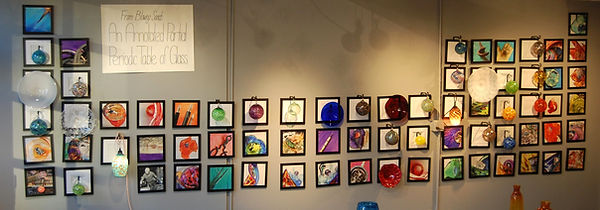
Categories
Tools: H, Be, Y, Cs, Zr, V, Mo, W, Rh, N
Colors: Cr, Ni, Mn, Au, Ag, Fe, Co, Cu, Cd, Sn, Se, Cl
Glass: Li, Mg, Ba, Na, Ca, K, B, Al, P, O, S,
H is Hydrogen Hydrogen has a notable role in the glass studio as an element of H2O. While a glass blowing studio is known for its fire and heat, water is actually an important tool for the glass blower. Molten glass, for the most part, doesn’t want to be fought with or pushed and pulled too violently. Water can allow for deliberate shaping the glass responds well to. Wooden shaping tools are kept in water so they will release a little layer steam when they contact the hot glass, giving the glass a gentle shaping. And, everything you make has to come off the pipe. It’s a most satisfying moment, when David has finished a piece and necked down the glass to a narrow connection point holding it onto the pipe, he dips the end of the tweezers in water and drips just a few drops of water to the neck to add a little thermal shock. Then he carefully carries the piece to the ‘knock off’ table and with a tap on the pipe, the piece cracks off just where he asked it to.
Li is Lithium Lithium, as Li2O, is less than 1% of the composition of the clear glass we're melting in our glass furnace. Currently we buy the glass in the form of 'cullet', small discs of glass, made by the Czechoslovakian company Bomma. Lithium is one of several ‘fluxes’, which are added to lower the melting point of the glass. Our furnace is set to about 2200F. Melting pure silica is done at temps of around 3100F, so adding fluxes really makes a difference. How this works is the SiO2 in 'sand' form has a nicely regular tetrahedral atomic structure. When melted and cooled to a glassy state, there is still a network of silica and oxygen atoms, but if you put Lithium in (or sodium or potassium or other alkali flux), they act to keep some of the oxygen atoms from connecting. The 'disrupted network' means lower melting temperatures, and using a variety of fluxes also takes advantage of the range of qualities they can each provide to the glass. Lithium aids in reducing the viscosity. David says the glass is 'soft' or 'hard' to describe how the glass’ viscosity feels.
Na is Sodium Sodium, as Na2O, is 5-15% of our clear cullet. The type of glass we're using is known as 'soda-lime-silica' glass . Soda is a 'flux' which lowers the melting temperature of the glass significantly, which is great in that you don't have to use as much energy to get the glass to a working temperature. The thing is, sodium silicate (without the lime) is known as 'water glass' as it can be dissolved in water (actually sodium silicate is an old-timey mixture used for storing eggs.) So other additives are needed to make the glass useable.
K is Potassium K2O 5-15% Bomma. K is another a flux to lower the melting point if the silica. Potassium particularly gives glass a higher index of refraction (better clarity) and makes the glass more durable. An early source for this was burning wood. Medieval-period European greenish glass made from sand and wood ash is called ‘forest glass”.
Cs is Cesium Cesium is used in some specialty glasses, not really in the art glasses we're using. But since it is a part of 'atomic clocks' & glass studios are all about timing, lets talk about that…Timing means the second-to-second counts in front of the glory hole where the artist keeps the glass just hot enough it is workable, not so hot that it is out of control and never so cool that cracks off the pipe until you want it to. And at the end of the day, when the pieces have been put in the annealer, you set a program that does the all important job of controlling the timing & temperatures which shepherd the glass from very hot to room temperature. Note from a glass blower's spouse: After decades as a glass blower, the tempo of glass blowing seems to be David's natural speed. I see it in the way David butters his bread, or brushes his teeth, walks the dog or even how he talks. There is little hope in asking him to hurry if we are running late.
Be is Beryllium Beryllium is used in electronics. Much of a glass blower's life may be analog, but the controller attached to the annealer is a very important piece of electronics. Glass isn't properly 'finished' after it is just off the blow pipe. At that point the outer surface of the glass and its interior can be such different temperatures that the piece has internal strain that needs a proper cooling regimen to relieve. All the glass we make is put in the annealer and kept toasty while we're working. At the end of the day we lock the annealer's lid & press some buttons on our annealer's controller to start a program that brings the glass from a working temp to its' annealing temperature, then hold it there for a nice temperature soak while the internal strains relax. Then the program slowly ramps the temperature down so we can sleep soundly and come back in the next day, take the pieces out and turn the annealer back up to start the process over again.
Mg is Magnesium MgO <1% in Bomma glass cullet. Another flux. SiO2 can use all sorts of help to make a good glass, and Magnesium is one of the 'alkaline earth' elements (along with Ca and Ba) that enters the SiO2 network with a larger size and larger charge (+2 vs the +1 of the elements called 'alkalis', Li, Na, and K.) The alkaline earth fluxes keep some oxygens busy, but not as many as the alkalis, so some melting point reduction, but not as much. The plus side is they add some element of hardness and density. Mg makes the finished glass more durable and the molten glass more workable.
Ca is Calcium CaO 5-15% in Bomma cullet, the 'lime' of our 'soda-lime-silica' glass. You might have used lime in your garden if you have acidic soil. In glass, it is another flux lowering the melting point of the glass, & it's the one that gets most of the credit. About 90% of all glass has CaO in the recipe. It increases the hardness of the finished glass pieces and can aid in reducing air bubbles, and CaO also has the advantage of being a cheaper ingredient...you can get it from limestone or seashells or chalk. A first written recipe for glass is on an Assyrian cuneiform tablet from about 650 BC: "60 parts sand, 180 parts dried seaweed powder and 5 parts chalk." It looks like making glass back then was prone to difficulties a modern glass blower can sympathize with, "When you lay the foundations of a glass-making kiln, [you search repeatedly for a suitable day] during a favorable month, so that [you may lay] the foundations of the kiln.
Ba is Barium BaO is 3-5% of our bomma cullet. Barium increases the refractive index of the glass. This gives gives the glass that shiny look. The large Ba2+ ions (large for ions) fit themselves in between the rest of the network of the Soda-Lime-Silica glass (glass is a solid with a non-crystalline structure, but there is enough of a network to call it 'a network'.) So light hits the glass with Barium in it & it has that sparkle we love to see.
Y is for Yttrium Yttrium is broadly used in modern LED lighting. If you are making your own color from raw material, you do some 'mixing' to get the desired color, But glass artists often do not mix their own colors, instead buying pre-colored glass in the form of color rods or ground 'frit.' These glass colors don't mix the way paints would. You aren’t stirring blue and red frit together to make purple. But the transparency of glass does mean you can play with interacting layers of color.
Zr is Zircon The glass furnace is primarily made of alumina silicate refractory bricks, but the studio also uses a number of other specialty fiber blankets and the like with components such as Zr to manage the high temperatures that occur. David built his own glass furnace (with some help.) It holds a crucible that can melt up to 100 pounds of glass. Except for maintenance periods the one he's using now has been running since 2008. The walls are about 8" thick and made of insulted firebrick and a mix of vermiculite, perlite, and calcium aluminate cement with a steel frame. It runs on natural gas (if he were building today, he might choose electric, but a gas furance is what we have at present.) When I starting dating David, he'd already been a glass blower for almost 30 years. I rapidly learned how much of life revolved around his furnace, this other object of his affection. The furnace's gas and air settings need adjusting, the furance needs feeding (of a sort--adding glass to the crucible to melt.) David is happy on days when , "the furnace gods were smiling" or frets over a fix needed. So this has become less about the science of refractories and more an anthropomorphizing of the bunch of bricks meant to keep the precious glass crucible toasty. And how quickly you can come to care about the things that are important to people you come to love.
Hf is Hafnium Hafnium. David's college life wasn't just fun learning to blow glass and making glass colors in the glass lab, he also studied materials. He even got to take part in a project tracing the transfer of porcelain technology from China down the silk road to Europe. He even tried an ancient glaze recipe. The results weren't pretty. But that taught him that it wasn't enough to just know the materials used, your need the expertise in all the processes involved in making something. And, though David ended up pursuing the craft of glass blowing, reading about others' exploits as materials archeologist is still very interesting. Which brings us to Hafnium and an article found online via Nature Scientific Reports "‘Alexandrian’ glass confirmed by hafnium isotopes" which discusses how they've found a way to differentiate whether artifacts are from Egypt vs the Levant (modern day Syria/Isreal areas), both areas that had early factories making large glass slabs which were broken up shipped out to be used by glass blowers all the way back in the first century CE...a system much like the cullet we purchase and melt to make our glass pieces.
V is Vanadium Vanadium is a component of steel and a ubiquitous use of steel in the hot shop is the blow pipe. Going from a student or renter at the mercy of the pipes your rental studio offers to admitting you are serious enough about glass blowing to sink some money into your own blow pipe. David's first pipe purchase was technically not a blow pipe, it was a 'bit iron' and he used it to make marbles. Now he has many blow pipes. Along with 'bit irons' for smaller pieces or bringing an additional 'bit' of glass to add to a larger glass piece, there are 'gathering irons' which are a little larger, or 'punty rods'. Punty rods can be used as a bit iron or they can enable a partially made piece to be transferred so the side attached to the pipe at the start is now available for shaping. Pipes, which come in various sizes and weights, are sometimes referred to as 'sticks' as in a beginning glass blower trying to get more 'stick time' to learn the craft.
Cr is Chromium Now we get to colors! Cr is best known for making beautiful emerald green glass. There are several ways light can interact with glass to make color. You’ll find that many of the elements that give glass color are in the central part of the periodic table in a group known as 'transition metals.' You may think of ‘chrome’ the shiny metal. In glass Cr is one of the elements that produce colors through a process described with ‘crystal field theory’, or an alternate, ligand field theory. I have been attempting to write a description of ligand field theory (LFT) without using too much jargon, but after several weeks I am not sure I have had much success: Basically, when Cr2O3 is added to glass, the Cr bonds into the glassy network in such a way that it ends up being Cr3+…it is an anion with a positive charge, and the Chrome’s electrons have charge distributed in such a way that they are available to change state when energy from a photon of light enters the glass. And that change in energy state is an absorption of violet-red wavelengths of light. So…the light is transmitted to our eyes is green (all the other wavelengths – the absorbed violet and red wavelengths =green wavelengths of light.) Hopefully that is vaguely understandable and close enough to correct. (For other people’s explanations please see the list of references at the end!)
Mo is Molibdenum In the hot shop, Molibdenum is important for its role as a component of the metal in the tools. One of the tools specific to the glass studio are the 'diamond sheers.' When they are partially closed the overlapping blades meet at top and bottom, leaving a diamond shaped void which the glass blower uses to grab the glass. The tips, too, have a special curve to them allowing for a smaller grip used to direct the 'bit iron' when an assistant brings over a secondary pipe with some additional glass to add to the main piece. I read about an archeological excavation of a glass works in Jamestown, Virginia where they found glass and furnace relics, but no tools. I think it sort of makes sense. A glass blower may leave a furnace, but it is hard to imagine them parting with a good set of tools.
W is Tungsten Tungsten is a component of some types of steel used in making the picks and tweezers a glass blower uses to manipulate the glass. One of the most important metal tools are jacks, 'the Swiss-army knife of glass blowing'. (And yes, jacks are usually made of steel with Si, Cr, and C, etc. and not W, but this is where they best fit in so…) They are shaped rather like large tweezers with a set on long duel blades for opening up or shaping vessels and necking down the connection to the pipe. The jacks' wide end is also a useful sculpting tool. Unlike some of the other tools, jacks are never dipped in water...that would just cool them off and slow them down. Instead, when we are making a light fixture David will spin his hand back and slide the blades through a lump of beeswax. He’ll spin the jacks back around and use them to open and shape the fixture. Sometimes the wax on the blades will light up with a small flame, like a candle burning inside the glass.
Mn is Manganese More colors! Manganese can be amber, amethyst, or it is a fairly well known for its use as a 'decolorizer'. That is if, say, you made glass with sand with a lot of iron impurities and you could add some Mn to make the glass appear clear. (it's because when you get the Mn and Fe together, they express the palest versions of themselves. Over time, in the sun, a process called 'solarization' can occur: The Mn2+ becomes Mn3+. Meaning the sun has photo-oxidized the Mn to appearing purpley-pink. You'd see this in older glass...like the purple glass squares in parts of Pioneer Square’s sidewalks. Now-a-days glass formulations have been refined to eliminate this effect.
Fe is Iron Iron can be pale green, because Fe2+in the glass results in absorption of red light wavelengths. Or in a furnace condition with more carbon and less oxygen (more oxidizing) it would have more Fe3+ anions and the color would be a more yellowy brown. Iron is a common impurity of sand which is the source of silica (SiO, the main component of glass) so old bottle glass was often a pale green color.
Co is Cobalt Cobalt makes such beautiful blues that it is no wonder this colored glass has been prized for thousands of years. Some of the earliest colored glass recipes were for making artificial gems. Early Egyptian beads were a material that was rather porous and not-quite-glass, “faience.” By Egypt’s 18th Dynasty they had figured out a lovely cobalt blue glass that continues to impress. There are ways to make cobalt form an octahedral coordination, then the glass color is pink and is not as deep a color. In Cobalt blue glass, the cobalt has a tetrahedral coordination with 4 oxygen atoms . Tetrahedral coordinated colors tend to be more intense.
Rh is Rhodium Rhodium (with Platinum) is found in some thermocouples. High temperature thermocouples let us know the accurate temperature in the glass furnace and annealer. The knowledge is nice in the same way a baker likes to be able to turn a dial on the oven and know the temperature the oven will heat up to. Accurate measurement makes things more sure and reproducible. It isn't that you can't blow glass well without a thermocouple. David told me that he was at a studio in France years ago where each morning they crumpled up a piece of newspaper and threw it in the furnace, counting how long until it was completely burnt and that was their temperature gauge. Simple enough.
Ni is Nickel Nickel in glass can make browns, yellows, greys, or some sort of purple shade. Some glass artists make batches of their own colors & years ago in college David did some of that. But that requires time & attention & space (each color would require its own pot to melt it in), so he buys colors in the form of crushed up glass frit or densely colored bars. The glass is from a few German companies and we don't have a listing of the exact compositions of the various colors, but we can make some good guesses based on what we know. For example, there is a whole chapter on Nickel in David's old copy of Weyl's 'Coloured Glasses.” The first line in the chapter, “Nickel has never played a major role in the production of coloured glasses and glazes.” So, most of our colored glass won’t have much, if any Nickel. But it is an interesting example of a metal that can make a variety of colors. Weyl’s explanation of the ‘how’ of that has is to first look at the base glass you’re putting the Ni into. Ni will color things differently depending on the other things in the glass, in part because it will be in competition for oxygens to bond to. Will Nickel be able to make a four-fold or a six-fold connection? That and other factors will play in to the wavelengths of light absorbed.
Cu is Copper Copper as Cu2+ can be used make blue glass. Or Copper can make a deep-crimson ruby color. Copper Ruby is a tricky glass color, going from a beautiful deep red to a purpley-liver brown unless its conditions are met. When David was in college he made his own copper ruby colored-glass. A grad student showed him how to adjust the furnace and to watch for the black spots that should appear on the scoop. "If it's brown when its annealed, then re-anneal at 50 degrees higher. But," he says, "Who doesn't love a challenge?...It was my windmill." He did succeed and this color is still his favorite despite all the trouble it gave him. In this glass, copper is creating 'nanoparticles', microscopic particles in the glass. There are two things at play with these: Absorbing wavelengths of light and scattering light. If there is a bit more absorption than scattering the net effect is green green wavelength absoprtion, thus the glass will look red. If the nanoparticles grow, then light is scattered by them and the color is due less to absorption and more to scattering and the glass then gets purpley. If the nanoparticles grow even more, the glass looks opaque and a livery-brown color. The glass blowers job is to carefully calibrate the temperature and timing and other factors to get the desired color in a process called ‘striking’. Gold does this, too, so read more there…
Ag is Silver Silver is known for a yellow-y silver stain. But it also brings up reflection…when the metal gives a mirrored surface. It is fun to watch a piece of mild-mannered brown glass engulfed by David’s large fluffy-torch flame and turn into shiny silvery glass. That torch has a reduction flame, with more gas than oxygen. The silver moves onto the surface of the glass! The furnace, glory hole, and some of the torches let you dial in the percentage of oxygen to gas. David can use a reducing flame (like the big ‘fluffy’ propane torch), a neutral flame (just to provide heat to a specific area), or an oxidation flame (to reverse any reduction-shininess you don’t actually want.)
Au is Gold Pink! Or red! (Or brown with SnCl2.) Gold has been a known colorant of glass for many centuries, but the mechanism wasn't really unlocked until the early 1900s. Austrian Richard Adolph Zsigmondy was studying glass colorants and wanted to get a better look at what was happening inside the glass. He spent 7 years to make an ultramicroscope, through which he could see that the gold forms nanoparticules, extremely small colloidal metal particles in the glass (5 - 100 nm.) An everyday example of another colloid would be milk, which has very small spheres of fats and proteins suspended in water. When light shines through milk the spheres scatter light giving it that bluish-white color. The gold in the glass is doing two things with the photons of light: Scattering and absorption. (Same process takes place with copper ruby and some silver colors.) Open a brand new bag of gold glass frit and you’d find it pale—barely any color at all. The gold is in there, but bonded in with the SiO2 and it is in a “reduced” state (Au0 vs Au2+). As you heat the glass, the gold will instead start forming nanoparticles. Then, like copper, the colloidal gold is absorbing more than it is scattering, and the transmitted light we see will be red. The absorption is not the same as the moving electrons from one discrete energy level to another here. For the nanoparticles a photon of light is causing a push-pull of electrons at the surface vs positive ions at the center of the nanoparticles, and, when the nanoparticles are about 20nm the oscillation reaches a sweet spot of natural resonance, absorbing the green wavelengths of light in process called ‘surface plasmon resonance’ (“plasmon” is quantum mechanical term related to the collective electron oscillation…see notes for others’ more thorough explanations!) If the nanoparticles grow, the scattering of light is the dominant effect and the glass looks purple-y then opaque. David says gold colors seem less finicky than the copper ruby.
Cd is Cadmium Deep yellow. Or it can work with selenium to make orange or orangey-red.
Al is Aluminum Aluminum might be called a flux aid. When Al shares an oxygen with SiO2, the SiO2 bonds better with fluxes.
C is Carbon The most carbon-y feeling tool in the glass studio is probably the 'blocks'. They are a cup shape of carved wood at the end of a wooden handle. It's usually carved from fruit wood, cherry is nice since it absorbs and releases water well. You use the block to smooth out the glass with a little cushion of steam. The blocks need to be wet to work, which means you keep them in buckets of water. And you need different sized blocks; we currently have everything from small 5's to a 16. (The number indicates the measurement in cm across the open end of the cup.) The glass does burn through the blocks over time. As they wear they change sizes. I write the block sized used in David's notes: 'blocked brand new 5 block' or 'easy fit in burnt in 5 block' or 'comfortable fit in burnt out 5 block.' I just counted 26 blocks in 15 of the buckets around the studio.
Si is Silicon Silica, SiO2, is the usually first thing people think of when they are considering the components of glass. SiO2 makes up about 70% of the glass. The reason non-colored glass is transparent while being a solid? A quick answer is because all the things that make colors appear aren’t happening. Photons of light don’t excite electrons enough to move to higher energy levels, and light isn’t scattered, or absorbed somehow. At least within the visible range. UV light can be absorbed by clear glass, our eyes just can’t see that.
Sn is Tin Tin is a part of the recipe for ' gold aventurine.' It involves heating a soda-lime-silica glass while adding a whole lot of copper, iron, and tin oxides. Then adding a bit more. Then cooling the glass in an 'reducing atmosphere', which means cutting out a lot of the oxygen supply. Any oxygen that is around will prefer to mix it up with the iron, and the copper crystals will stay shiny while they grow. It is called 'gold aventurine' to differentiate it from 'blue aventurine' (which has cobalt) or green aventurine (chrome), etc., but it isn't really gold. There is a story of a glass maker (or monk) having an accident ('a venturi') with some copper and glass and discovering this recipe for aventurine. Seems doubtful. And apparently the process was so special that it wasn't widely shared and was subsequently lost. Then found and then lost again and then figured out again. Also, the crystals are ruined and the piece will lose its sparkle if you let the piece get a little too much oxygen or heat while you are working the glass, so it's a bit persnickety.
N is Nitrogen For Nitrogen, [-CO-C6H4-CO-NH-C6H4-NH-]n is the chemical formula of kelvar. It is easy to forget how amazing it is to be able to pick up a hot glass piece and carefully cradle it in your hands, just for a moment, and know that you have gloves with layers of kevlar and wool protecting you as you put your work into the 925F annealer. We also have kevlar gloves to ease the heat on the forward hand while gathering from the glass furnace, kevlar sleeves to keep the heat from the right arm while it does all the shaping at the bench, all with varying amount of singing on the palms or fingers. We also have a pair of mittens, with a flat outer weave and many layers of wool with big oven-mit hands we use for catching pieces if needed. When I put them on I feel a bit like a gingerbread person (they're large-ish and I'm rather small), but they mean I am ready. David cracks off the piece off the pipe and it falls into my gloved hands, safe and sound.
P is Phosphorus In art glass CaPo4 can be used as opacifier to make milky white glass. Some of the earliest glass factories in the Levant and Egypt used natron for the soda element of their glass. Natron is a source of sodium that can be found in dry lake beds. Sometime between the 7th and 10th century CE more places began producing their own glass supply, and for a flux, instead of Natron, they generally used potash from plants or bone ash, which are a source Phosphorus. Glass blowing spread with this change. We watched a short film ‘The Glassmakers of Herat’ made in 1968. It showed glass makers in Afghanistan who made their own glass, showing the gathering and preparation of plants for making their glass.
As is Arsenic Arsenic ---Brown to black and reduces the green tint of iron and makes the color opaque
Sb is Antimony .5percent< of bomma
O is Oxygen Oxygen and its bonds with Si and other elements are such a key component of glass. But since I’ve already written about that some, here I will make mention of one of the ways things can go awry: Devitrification. Glass is supposed to be clear and beautiful, but sometimes it can have a patch that looks, well, scummy. The glass is partially crystalizing. Sometimes the glass gets a little too hot, sometimes it cools a little too slowly. Some glass compositions are more prone to devitrification than others. It’s all about keeping that internal network structure network-y vs crystalline.
S is Sulfur Sulfur, along with iron and carbon, can make a warm amber colored glass. This color is particularly good at filtering out UV light, making it good for storage of sensitive liquids. L’Arte Vetraria is the 1612 glass color recipe book by Italian glass blower/alchemist/priest Antonio Neri. An Italian glass recipe book from 1612? Yes, many glass blowing technical secrets were held closely by Italian glass blowers of the time, but Antonio Neri was perhaps a special case in that his father was a physician for the Medicis, and Antonio was in Florence and Pisa and even lived and studied in Antwerp for a time, so maybe that all gave him a pass to publish. Anyway, in chapter 65 he writes about making colors, “You must be exact in the time, quantity, circumstances, and materials: for if you err but a very little in any of them whatsoever, all the whole labour and business is lost and comes to nothing.” (Sometimes he calls sulfur ‘sulfur’ and sometimes he calls it ‘brimstone’, which confused me for a bit.)
Se is Selenium Selenium makes red glass or a very bright orange when with Cadmium.
Cl is Chlorine Chlorine. You can make a soap-bubble-type iridescent coating on glass by, in part, heating stannous chloride crystals and spraying a layer on the glass. It is the type of effect you might see on a shiny Tiffany glass vase. When David was a young glass blower he worked at a studio that made iridescent pieces. The extra 'spray chamber' equipment is not something he ever felt compeled to set up when he put together his own studio, but the effect is another example of glass playing with light. Iridescence is caused by light going through a very thin film making an interference patterns. The 8th century “The Book of the Hidden Pearl” by Jabir ibn Hayyan is maybe the first glass color recipe books has instructions for a glass ‘which keeps changing colors.’ So maybe something similar?
SHARDS David is a great keeper of scrap glass so there were plenty of interesting shards to take pictures of. And in learning the history of glass blowers, it appears keepers of shards have a long history. Glass is remarkably recyclable. David makes all sort of things using his shards, and remelts them in the furnace. Adding to the melt he does judiciously so the batch in the tank isn’t tinted, but for the last few years he melts whatever scrap he wants for the month of January. Usually, he ends up with green or blue glass to have some fun with. I read about a 1970s underwater archeological find of the coast of Turkey, the ‘Glass Shipwreck’. The ship was likely taking glass from the Levant area to, perhaps, Istanbul in about 1025 AD. They found glass ingots bound for glass factories and glass factory scraps. Around 3 tons of glass at the bottom of Serçe Harbour. I look around the shop at my husband’s wonderful hoard of glass shards and think, “Keep recycling your scraps, David. You’ve got a ways to go.”
SOURCES OF INTEREST:
General Color:
Colour and the optical properties of material by Richard J.D. Tiley (a text book about all sorts of light and color. More than I could read in total at the moment, and mostly for advanced high school or college level)
Great explanations of four mechanisms of glass color and some interactive elements. For budding and adult science nerds:
https://jacob234.github.io/glass-color-explainer/
Corning Museum of Glass website (history, a dictionary, and research)
https://allaboutglass.cmog.org/?_gl=1*wq3ghd*_gcl_au*NDc4MTMyMDEwLjE3OTE3Nzg1MDc.
Hal open science, Georges Calas, Laurence Galoisy, Laurent Cormier. The Color of Glass. Encyclopedia of Glass Science, Technology, History, and Culture, 2020. ⟨hal-03450046⟩ (Textbook level explanation of glass coloration)
https://hal.science/hal-03450046v1/file/Chap%206.2%20-%20The%20Color%20of%20Glass.pdf
PBS video explaining some basics of glass production:
https://mail.google.com/mail/u/0/#inbox/QgrcJHsbkfZxjxKrxZgDbNzdWfWZCPwBBGq?projector=1
Glass:
Digital Fire (about ceramics, but glazes are glassy so it has much useful information that crosses over)
https://digitalfire.com/glossary/flux
Mark Miodownik
https://ed.ted.com/lessons/why-is-glass-transparent-mark-miodownik
Elan technology, glass fluxes and modifiers
https://www.elantechnology.com/support/technical-library/glass-fluxes-modifiers/
True Geometry blog about fluxes
https://blog.truegeometry.com/api/exploreHTML/00bbc53b7c0c51f58566552ab2ead10a.exploreHTML
History:
Conciatore blog by Paul Engle (Antonio Neri and Venetia area glass and history. So interesting!)
https://www.conciatore.org/
The Tools Of America's First Glass Blowers by J. C. Harrington (Jamestown, VA glass blowing archeology)
https://www.eaia.us/post/the-tools-of-america-s-first-glass-blowers
The Glass Blowers of Herat (30 minute film from 1968 that shows glass blowers in Afghanistan using materials and techniques that had been in their family for 200 years. Especially liked seeing where they got their glass making supplies.)
https://www.youtube.com/watch?v=BMYE83DJU4Q
The Discovery of Iridescence on Glass © Glen and Stephen Thistlewood, originally published October 2017. Updated June 2024. (Jabir ibn Hayyan, Leo Valentin Pantocsek, Tiffany, and Steuben)
https://www.carnivalglassworldwide.com/leo-valentin-pantocsek.html
Cuniform tablets
https://isaw.nyu.edu/exhibitions/ishtar-gate/objects/tablet-glass-recipes
Glass shipwreck
https://nauticalarch.org/projects/serce-limani-shipwreck-excavation/
https://en.wikipedia.org/wiki/Ser%C3%A7e_Liman%C4%B1_Shipwreck
Gold:
Gold nanoparticles: https://www.nottldr.com/NanoArch/why-gold-turns-red-at-the-nanoscale-plasmonics-explained-0ivhv9m
And Wikipedia…So handy for an explanation of terms I didn’t know!